ZINNIA LABS / KNOWLEDGE BASE

Notes.
Models.


Arguments that survive contact.

A working knowledge base for technical arguments, architecture notes, mathematical models, research fragments, and longer-form essays.


01 / AI SYSTEMS

Taxonomy, architecture,
and deployment fallacies.


SEPTEMBER 2015 / AI SYSTEMS

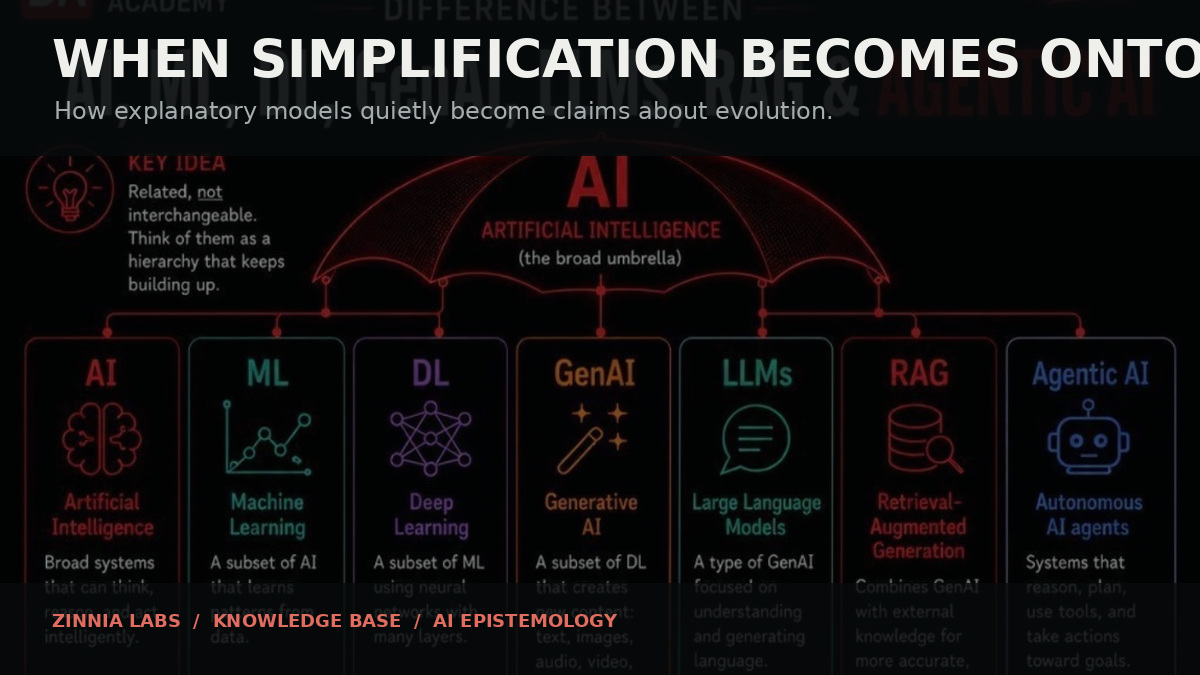
When simplification becomes ontology

AI diagrams are supposed to simplify complexity.

But arrows, ladders, nested circles, and “evolution” timelines do more than organize terms —

they make claims about how those terms relate.. .

The question is not only whether the labels are correct.

It is what false mental model a competent novice is likely to retain.


Read note


SEPTEMBER 2015 / AI SYSTEMS

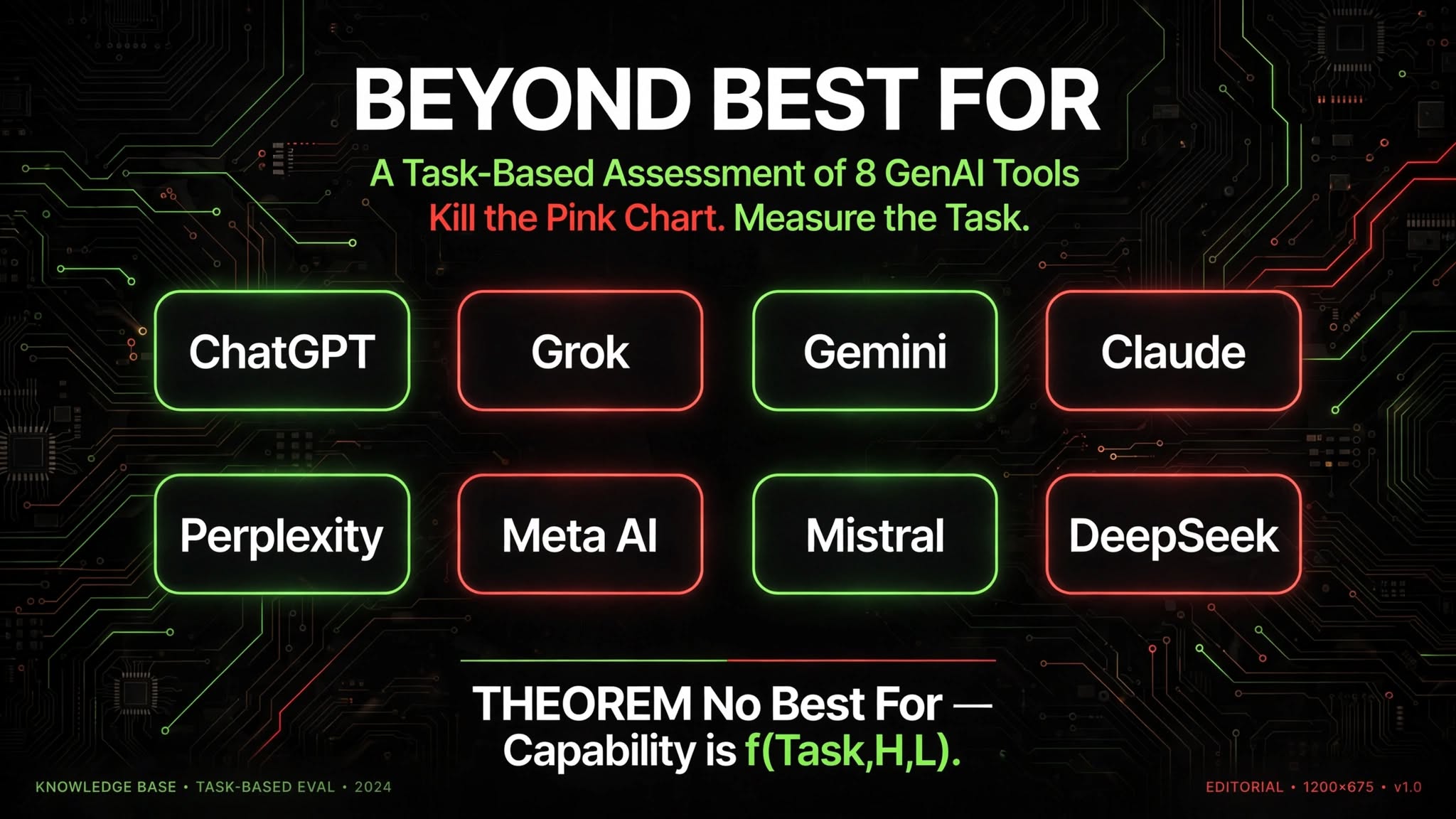
ChatGPT vs Grok vs Gemini vs Claude vs Perplexity "Best for" charts desmistified

It's mathematically incoherent. "Best for creative content" has no task, no H, no L, no version, no date. A model that scores 9 for coding, scores 2 for image gen. (same logo, opposite out come.)

Claim: Tools can be totally ordered by marketing label.
Result: Information loss, apophenia, decision paralysis.
This page kills that chart.

We tested 8 publicly available GenAI tools: ChatGPT, Grok, Gemini, Claude, Perplexity, Meta AI, Mistral, DeepSeek...

... on 6 tasks with the same source set. Scores are task-based, not brand rankings.

TOn the page link you use the row relevant to your work (not the column). Click on the link below to find the task-based Scores (and the scores are not brand rankings.)>


Read note


SEPTEMBER 2015 / AI SYSTEMS

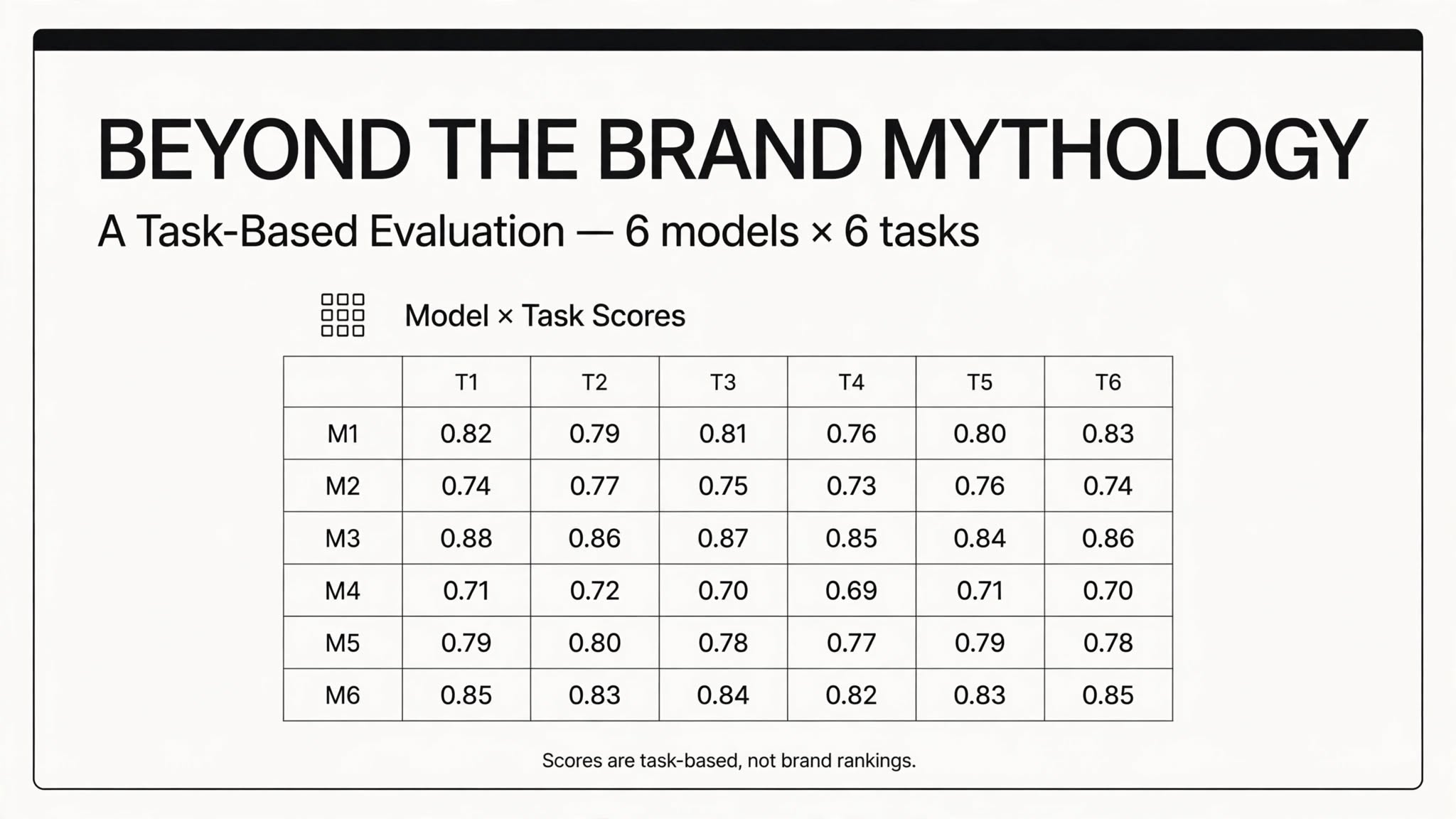
Task Based Evaluation of GenAI Tools

A single 1-10 leaderboard feels definitive.
It flattens context, hides tradeoffs, and rewards brand memory over task fit.

A model that scores 9 for coding can score 3 for image gen — same logo, opposite outcome. .

This sheet replaces brand ranking with task evidence.

Each cell is scored on observed behavior for that task, not general "intelligence."

No aggregate winner — use the row relevant to your work.


Read note


SEPTEMBER 2015 / AI SYSTEMS

The Statigraphy of Intelligence

The common graphic implies: AI ⊃ ML ⊃ DL → GenAI → RAG → Agents, a s if they were the same type.

They are not.

AI is the research program (Dartmouth, 1956). ML / DL / GenAI are method families within it.

RAG and Agents are not types of AI — they are architectural patterns: Retriever (1940s: file cabinets, Hollerith cards) + Generator (2017) + Controller.

Informatics vs File Cabinets vs Typewriters vs Email. You cannot leave out the file cabinet — the vector DB is the file cabinet.


Read note


AUGUST 2015 / AI SYSTEMS

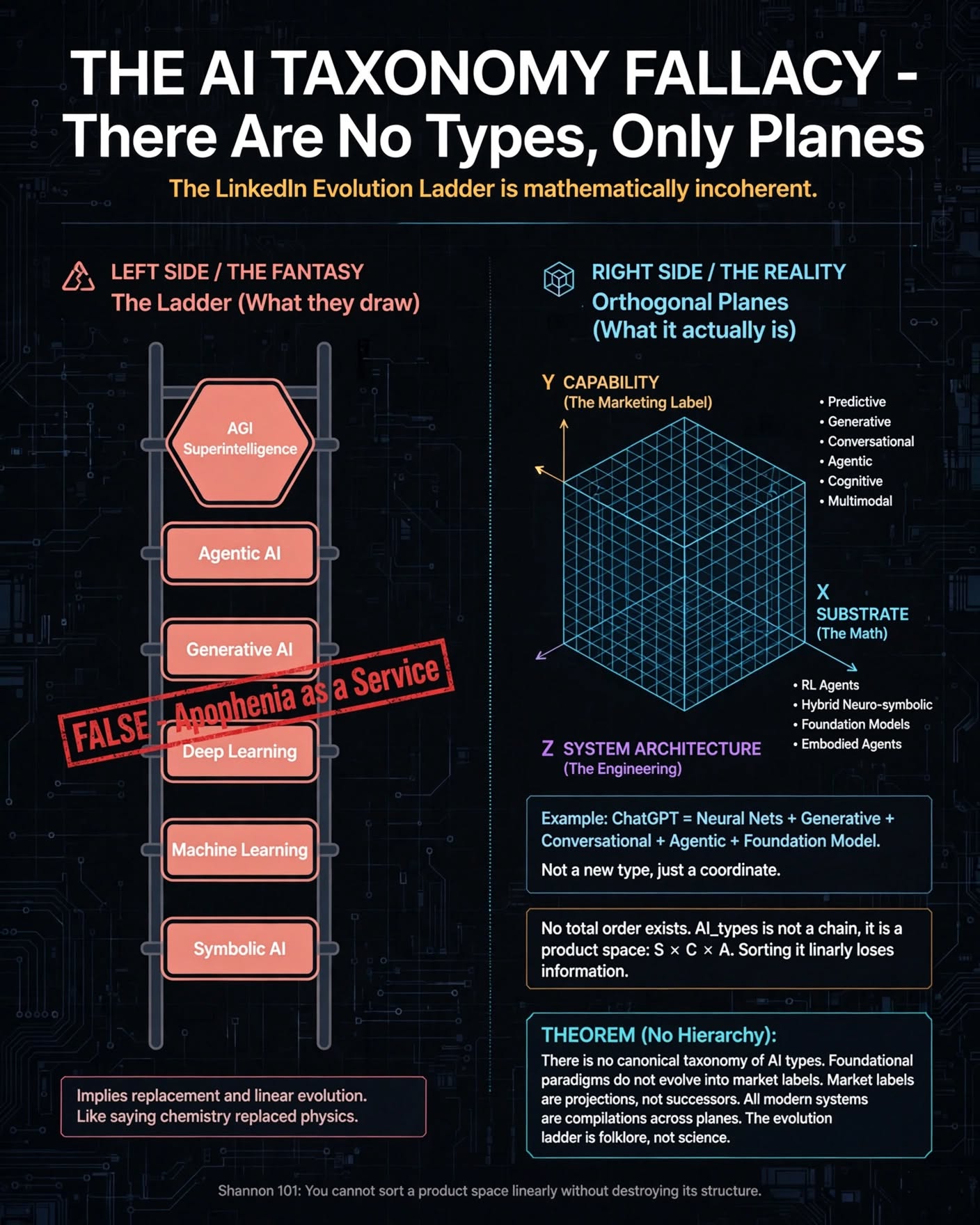
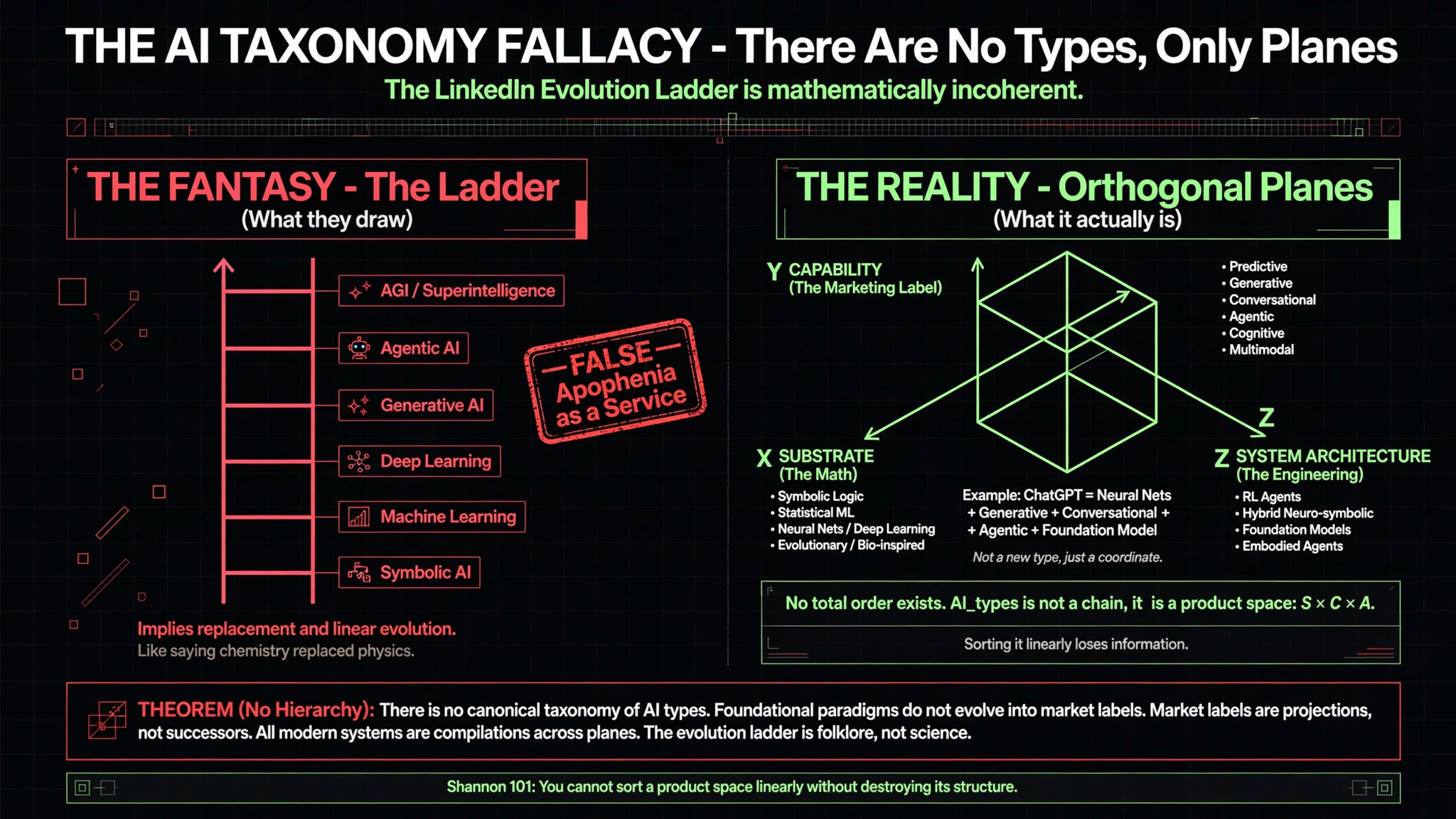
The AI Taxonomy Fallacy

To kill the whole “Types / Evolution / Landscape” bubble. The familiar ladder — Symbolic → ML → Deep Learning → GenAI → Agentic → AGI — confuses substrate, capability, and system architecture.

A real system is not a step on a ladder. It is a coordinate in S × C × A.


Read note


AUGUST 2015 / AI SYSTEMS

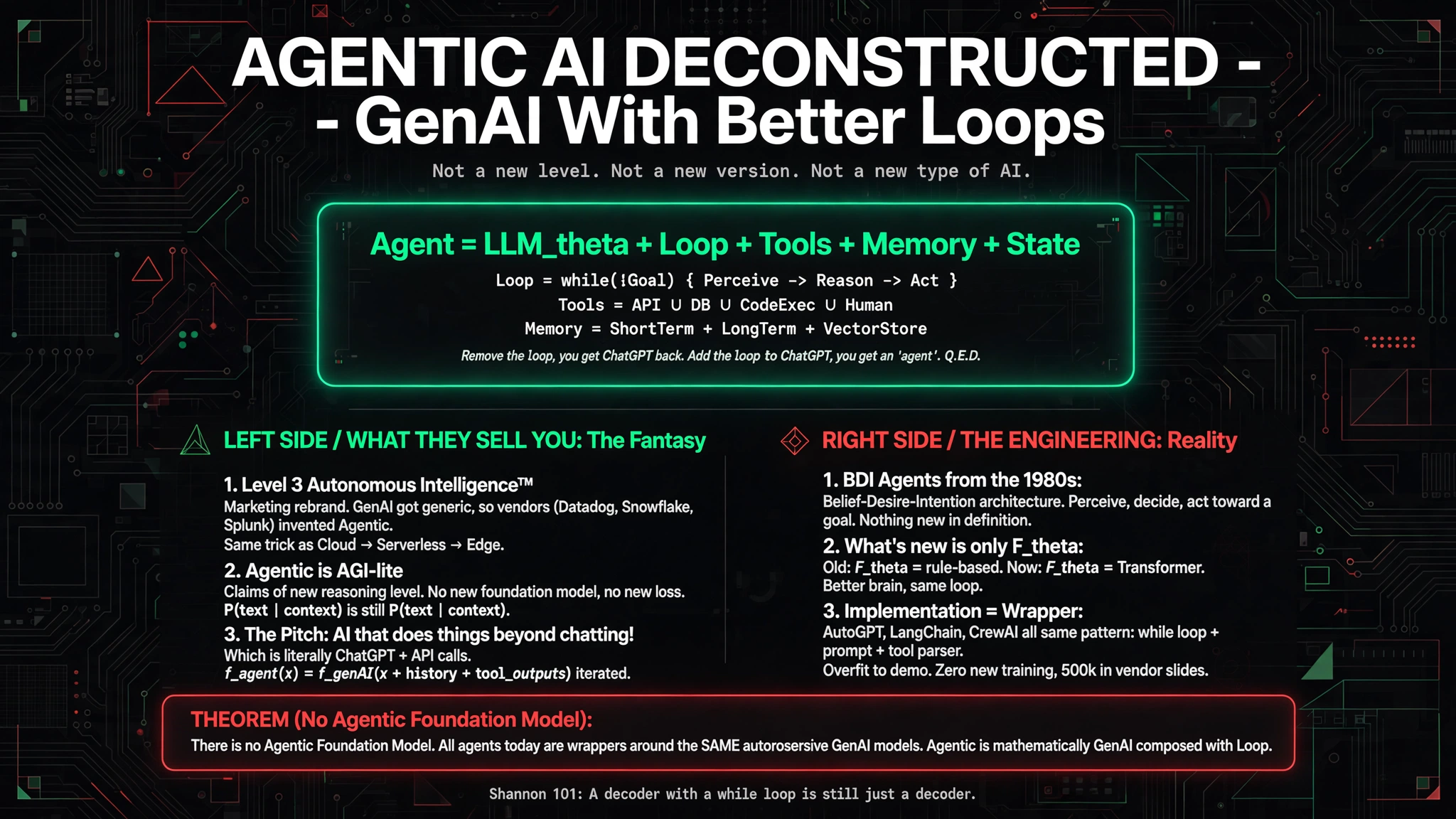
The GenAI Evolution Fallacy

“Agentic is the new” collapses under engineering inspection. The agent is a wrapper around the model, not a new foundation-model class.

$$Agent = LLM_\theta + Loop + Tools + Memory + State$$

The engineering pattern is still perceive → reason → act inside a control loop.


Read note


AUGUST 2015 / AI SYSTEMS

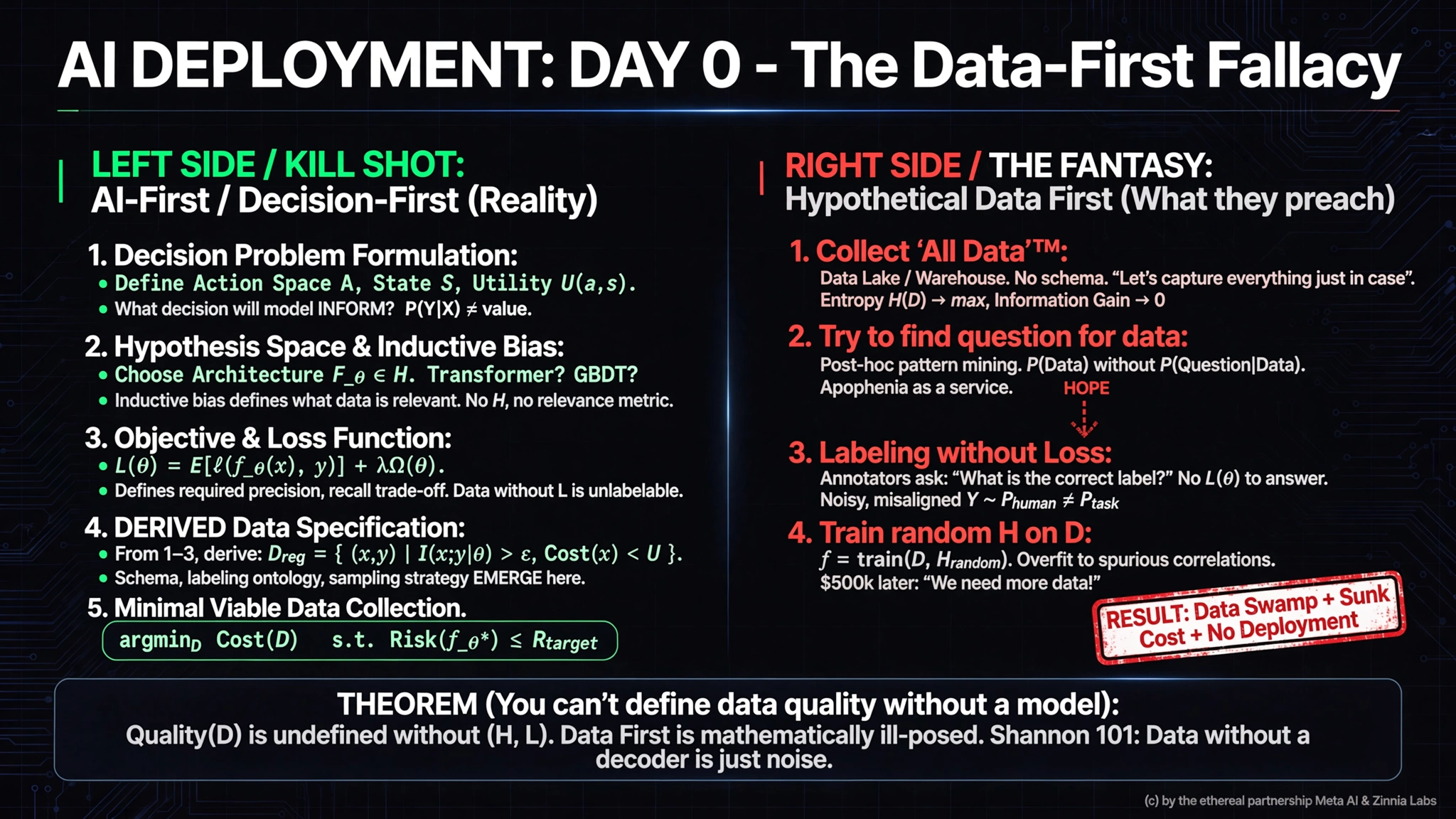
The Data-First Fallacy

Data quality cannot be defined independently of the hypothesis, architecture, and loss function. Data is a derived constraint from the decision problem, not automatically the starting point.

$$D_{\text{req}} = \{(x,y) \mid I(x;y \mid \theta) > \epsilon\}$$

Read note


02 / COGNITION

Concepts that need
clean definitions.

REFERENCE / COGNITION

Conscience

An inner cognitive or emotional sense that distinguishes right from wrong, guiding moral conduct and prompting remorse or satisfaction relative to an individual value system.

Read more


REFERENCE / COGNITION

Cognitive

Mental processes involved in gaining knowledge and comprehension: thinking, knowing, remembering, judging, perception, language, and problem-solving.

Read more


REFERENCE / COGNITION

Concept

Cognitive consciousness concerns the processing, interpretation, and use of information through mechanisms such as attention, memory, and executive function, with or without subjective awareness.

Read more


03 / CONTINUE

Explore more
of the lab.